The Beginning
What if I let it all pour out of me?
What if I allow it?
What if I embrace it?—
The hurt
And the happy.
What if I honor it?
What if I wear it on my skin
as my signature scent?
What if that’s the good stuff?
– embracing the process – sharing the work –
The Beginning
What if I let it all pour out of me?
What if I allow it?
What if I embrace it?—
The hurt
And the happy.
What if I honor it?
What if I wear it on my skin
as my signature scent?
What if that’s the good stuff?
This December was particularly challenging for me. I was reaching a tipping point of discontentment with my work, my habits, and with the kind of person I was choosing to be. On top of my usual familial hurdles, I was facing the end of a relationship with someone who (and I don’t know why I’m surprised by this because this is the toxic self-defense I engage in most frequently) mattered much more to me than I let myself know. Even though we hadn’t discussed it yet, I could feel the distance building, and it was breaking me. Also, I was personally witness to the agonizing death of the most important and influential matriarch in my life. And, my car was struck while parked, and rendered inoperable two days before Christmas.
As I sat in my rental car on the long drive home for the holidays, I spent some time reflecting. There’s a threshold I reach when dealing with certain people in my life. It’s the moment when my care for them sacrifices care for myself, when we’ve cycled back to the same destructive behavior I’ve been witness to and sometimes vicim of for our entire relationship. Most of us have people like this in our lives. In this moment, as the threshold is breached, I am immediately consumed by rage. Not at them. You can’t mad at someone for being who they are. I’m mad at myself. Because it becomes apparent that I’ve not yet loved myself enough to stop going down that dead-end road. This is a large part of the work I’m trying to do, and it’s a challenge. It’s the challenge of coming to terms with the fact that there are certain people in my life from whom I need distance. That the strongest and happiest version of myself thrives best without them. And that, in my case, those people that often cause the most pain, are the ones biology and precedent tell me are supposed to fix it. So, in light of where I was coming from and what I was heading to, I was determined to set boundaries on this trip. To never be anywhere if it would hurt me. To take care of myself. This IS good work. But I was less than optimistic.
I felt tired and sad and lonely and lost. When I got to town, I stopped for a shot of whiskey and a beer. That was before I even got to my mother’s doorstep. When I did finally arrive, I put my bags inside and immediately felt the limit of my new boundaries being tested. So, I left. I headed to one of a few places still open after 11 PM in my small hometown—another bar. On the way there, my random song selector chose the song “She Used to Be Mine” from the musical Waitress. It’s a song about losing sight of yourself. I sang along and sobbed aggressively the way you do when the right art tracks you down at the right moment. When I got to my destination, I grabbed a beer and took the last empty seat at the bar, hoping to sit in peace and continue to feel sorry for myself. Or at least that’s the narrative I had constructed in my head. But I’m a liar. Especially to me. As I write this, I know why I really went there. The best part of me was hoping for a night exactly like the one I was about to have. After I sat down, the man beside me, also alone, turned and said something. I don’t remember what. I responded curtly and shifted away slightly. He continued. Not a line. Just a pleasantry. And within a minute, his kindness pierced my cynicism. Suddenly, two strangers were sharing everything from politics to experiences of guilt, grief, and loss.
My new friend was not just a U.S. marine, but a four-star admiral. When he was deployed, his field was Medical Evacuations. And this evening, he was celebrating his remission from cancer. He told me that he was currently on track to be a doctor, specifically a pediatric oncologist. That he was inspired by the strength of the children he witnessed while undergoing his own cancer treatment. That he often felt they were much braver than he was. And that he wanted to devote his life to them. I told him I was having a difficult time. He told me about his year. He had lost his dog, his wife, and his health in the span of a single calendar.
I asked questions about his time in the military. He told me about the system of tagging the injured. That a red tag means that the amount of time you will spend trying to save this one soldier is not worth all the other lives you could save. That their injuries are too great. That the goal for a red tag is comfortable death. He told me about the time a man he knew personally, a man he joked with earlier that day, a loving husband and friend, was tagged red. That against orders and reason, he tried and failed to save him and has never forgiven himself for doing exactly what his job required. I cried again. I’d lost track of how many times that night. But this time, it was for him. We talked about coping and the gallows humor of those in his profession. He told me some of their jokes. We laughed together. We talked about the veteran suicide rate. It’s often cited at twenty a day. Everyday, twenty veterans unequipped with adequate mental and physical health services decide the best solution is to take their own life. We talked about the day he considered it. The eve of his first cancer treatment when his ex-wife, who he still hoped to reconcile with, told him she was pregnant with their friend’s child. That the dark humor of one of his brothers in combat was the rope that pulled him out of that hole.
We chatted intermittently with the man beside us. He was watching me; I had tracked his gaze from the moment I sat down. The man shared an anecdote in which he was deeply offended to have been hit on by another man when he “clearly” wasn’t interested. My new friend asked the man beside us how often he thought the same thing happened to me. I felt a rare kind of gratitude. I can count on one hand the number of times I’ve felt that kind of grateful. We asked more questions. We learned that the man beside us had a gay brother. That he had watched his brother suffer from depression until finally, in the late eighties, he took his own life. I saw a flash of sadness behind his stubborn face.
In three hours, I received a masterclass in perspective. My worries melted, and all I felt was gratitude. My new friend was three years younger than me and carrying everything we discussed with a smile. His positivity was radiant. His care for me–a stranger–was evident. He told me his three rules for living. I wish I had paid better attention, maybe taken notes. I only remember the last one: Leave every person better than you found them.
At the end of the night, we exchanged a pleasant “see you around.” And then, I left.
There is no depth to my gratitude for him and that night. He changed me. With kindness, vulnerability, and three hours time, he changed me. He left me better.
The good of this world can change you, too, if you let it. It’s there so much of the time. We’re taught to learn from our mistakes and often this leads us to distrust. To making the safe choice. To closing ourselves off. To assuming the worst. There’s a lot of space between being careful and being closed. That’s the space of “Letting.” Letting the good in. Letting yourself be moved. Letting yourself go. Wherever your mind, body, or heart need to go. Whenever you know it’s time. When it’s very, very hard. Let yourself go. Let yourself be changed.
For a stretch of my childhood, my dad stayed with my grandma and grandpa. “Lived” would be too strong a word, as he was a very transitory creature in those days. On his court-mandated weekends, I would alternate between sleeping on the pull-out bed in their living room or in their spare bedroom. It wasn’t until about 15 years later, as I made my last of multiple Christmas Day stops, a practice well-known to children with less-traditional family structures, that I realized my most tangible feelings of “home” are associated with my grandparents and that house.
I can still recall the sound of the steady whirring of the ceiling fan above the guest bed and the measured ticking of the old clock on the mantel, the familiar scent of wild mint that had overrun a portion of the front yard, the bright citrus of the lemon tree out back, and the feeling of burying my face in the soft belly of their fluffy orange tabby, Oscar. I once forgot to tell Oscar goodbye and begged my dad, through tear-filled eyes, to circle back. He did. (It’s a story that still elicits laughter at family gatherings.) You see, even as a child, I understood impermanence. I couldn’t risk losing the opportunity to tell my scruffy orange friend how important he was to me and how loved. This is one those precious, innate qualities, diminished by the cynicism and angst that comes with age, I have spent years trying to reclaim for myself—the simple ability to proclaim love and appreciation at the moment it’s felt.
My grandpa’s den is still full of a lifetime of tools and trinkets, collectibles and doomsday supplies. Remember Y2K? He’s still ready. But my favorite detail has always been my grandma’s collection of wind chimes. It runs the entire perimeter of their house. Every other Saturday morning, as soon as my cartoons had ended, my dad lifted me onto his shoulders and we walked along the length of the house, pausing every few feet. Jingling, tinkling, jangling, and clanging pierced the crisp morning air. One by one, I would brush my hand against the glass, wood, shells and metal. Softly. With reverence.
This was one of the ways I learned to be gentle, to take care, and to appreciate the fragility of things. I learned to let go of assumptions. That the appearance of a thing has nothing to do with the quality of its output, as some of the simplest chimes made some of the sweetest music. Sometimes reality can bring a sound more beautiful than your expectations and sometimes those expectations are too high. I noticed that the most delicate sometimes hung beside the most hardy and that distinction wasn’t always obvious by sight. Rather it was in their songs and in the way they responded to touch. I was often overcome by the diversity of their sounds and excited by it—a tiny tinkling before the bellowing sound of thick metal pipes leading into the hollow knocking of wood. Sometimes we would wait until each had finished its song before moving onto the next to hear what melody and tone would greet our curious ears and sometimes we moved swiftly down the lines, touching as many as possible to hear what symphony they would make together. We would often spend nearly an hour doing this, only stopping at my grandma’s call to breakfast and the smell of bacon floating from the open kitchen window, and for that entire time, I was rapt. There was a magic in those moments. A focus. A bit of time and space transcended, hung in the air with the distant sounds of my grandpa clipping coupons from the paper and my grandma whisking eggs with a fork.
It’s funny; I’ve never asked my grandma why she likes them. Maybe she doesn’t. Maybe she had one gifted to her and then another and then it became one of those things. Thoughtful people assuming. Maybe she loathes wind chimes. Though knowing my grandmother, she would have long ago put an end to the nonsense, were that the case.
And so, the windchimes are part of her legacy now. They are forever linked in my mind. She is the unexpected music I hear floating on the air after a strong gust of wind. That sound, whatever version of it, always gently drifts my senses back to lazy Saturday mornings at Grandma ‘N’ Grandpa’s House, when the world was nothing but a pile of board games and a Tupperware container of homemade lemon bars. A kitchen table, so comforting in its predictably. With my grandpa, impossibly sensible and patient, and the satisfying sound of his steady coupon clipping, the giant metal-handled scissors, heavy and cold but somehow perfectly at home in his hand. They don’t make scissors like that anymore. Or grandpas, I assume. And Grandma with her crossword every morning—a practice I picked up shortly after graduating college. I needed some form of daily mental exercise. But also, I think, I needed to feel, in some way, close to them and those weekend mornings at their kitchen table where everything was safe and orderly and the day could be anything I decided. It’s the same way I feel when I hear the wind play the instruments we’ve hung for it. This is the greatest gift she never meant to give. And she has given me so much. My dad now has a collection of wind chimes across the front of his home. My aunts, too. I, bound by the confines of my LA apartment, have one. It’s hanging in my bathroom. As a recent visitor joked, it doesn’t catch much wind in there. But the sight of it always fills me up.
My most recent visit revealed the chimes to be nothing like those of my childhood memories. It has been over 20 years. Things age and fade and break. There’s that impermanence thing again. I asked about my favorite chime from memory—cascading, white, bell-shaped pieces hanging in a delicate spiral. My grandma didn’t remember it. My grandpa, ever the realist, reminded me that these things aren’t built to last.
I know I don’t visit them often enough and I’m not sure why. They’re still here. But I find myself avoiding them. I’m ashamed of that and that drives me further away. They’re older now, more physically feeble, but my grandma is still the sharpest woman I know. With wit and a delightful crassness yet to be rivaled by anyone I’ve met. But every day, they’re a day further from the images I have in my head. My spunky grandpa is a bit more forgetful than he used to be and he casually discusses his burial preferences. Every holiday is regarded as potentially “the last with all of us together,” but that’s always true. That’s what life is. Temporary. Unpredictable.
Still, I’m scared that next time will be the last time and that pressure is terrifying. Crippling, even. How do I pack 28 years of gratitude and reminiscing into an afternoon? And also, how do I show them that the distance I have created was not about putting space between us, but rather about making space for myself? And then flit back to LA neatly tucking away the guilt of feeling I’ve abandoned the people who have always loved me best? I know it’s not that difficult. I know I could just call. It makes no sense. This is what regrets are made of.———
It’s December, now. I wrote those paragraphs back in April. Back before my grandma was diagnosed with terminal lung cancer, more than twenty years after she quit smoking. Before it was decided she had only months to live. Before her body fulfilled that promise. Sometimes I write when I feel strongly about a thing. Mostly I write to discover how I feel. And, rarely does it end what it started as. I was able to visit two more times before the third—the day I got the call that if I wanted to see her one last time, I should come right away.
When she was alive, I constantly lived with the guilt of knowing how much she loved me and that my moments with her were always fewer and more scattered than those of the other grandkids. There are very few photos of the two of us. Squabbling parents and physical distance eliminated the possibility of casual pop-ins. As a child, the holidays I spent with her were determined by the court; as an adult, by how effectively I managed to divide my time—that special torment that comes with being a child of divorce: the guilt of constantly disappointing loved ones. Of never having enough time and never being in the right place. Even on Thanksgiving, the week before she died, I felt that familiar guilt ooze out of me as, yet again, I explained my absence to her. I’m sure she heard it, because the next thing she said was, “well, Honey, you can’t be everywhere at once.” With one gracious sentence, she absolved me. Of course. It’s simple and obvious. Of course, I can’t. I have been painstakingly aware of that fact my whole life. But hearing those words from her, uttered so simply and matter-of-fact, was exactly what I didn’t know I needed, and what I now believe to be her greatest gift to me. I will always be grateful for that moment. For her. And for her effortless understanding. When I got off the phone that night, I wept for nearly two hours. A deep and inexplicable part of me was certain that would be our last conversation, even as I promised to visit the following week. I could hear her exhaustion and pain through the phone speaker. Her body was quitting in a way her spirit never would. Only four days later, I received the call to come as soon as I could.
And by the time I got there, the fiercest woman I knew couldn’t speak in full sentences. She was disoriented, in extreme pain, and unable to perform, on her own, even basic actions. It was obvious she didn’t want to be seen that way, but there was no way around it. And truthfully, it’s hard to know if she even knew I was there. On her final night, I was awakened by the sound of her laboring to breathe. As I sat beside her, the absurdity of the situation swirled in my head. I had spent years afraid to visit. The more guilt I felt about time spent away, the more time I spent away, hiding in shame. An odd, fear-driven cycle. I thought if I could just come to them with some great accomplishment, it would justify why I was away so much. But that was an odd, deluded pressure I, and only I, had placed on myself, expertly getting in my own way. Meanwhile, time passed, lives were lived, they aged, and I missed most of it because I was afraid. Afraid to see disappointment in their eyes? Afraid to see if my absence hurt them? Afraid of watching my loved ones grow old and die?
As much as I claim pragmatism, I’ve always felt great discomfort with the end of things. Not necessarily endings alone, but the unchangaeble quality of them. The idea of finality. I much prefer to leave things open. I’ve often left the last chapter of a book unread or the final episode of a TV series unwatched, allowing the characters to live on. I don’t even decide an ending for them. I take comfort in the idea that there isn’t one. That their stories are still going. That they have options. (There’s probably a good 30 years worth of therapy sessions contained in those nine sentences.) On a personal level, I suppose this reveals a lack of faith and trust in a greater picture. It’s based in a desire for control and a need to feel able to affect an outcome however far down the road. Sort of an “it’s not over ‘till it’s over” mentality. But in death, it’s definitely over. There is nothing more unchangeable than death. No matter the circumstances, the outcome sticks. It’s over. Yet, there was a comfort in her passing, relief even, certainly not in the loss of her, but in the end of her pain. A permanent end to her suffering. An agreeable finality. A positive impermanence? Yes, the good will end, but so will the bad. And all those big, dumb, idiots who have told me, in moments of grief, that this too, shall pass, make a little more sense.
I sat with her, while the others who had been there all along got some much needed rest. Her hands were cold and swollen, clenched in fists at her side. I held them anyway. I felt a sense of comedic irony knowing that, were she awake, she would have only tolerated my grasp because she would have assumed I needed it, and I, only because I assumed the same about her. We were similar that way. But, seeing as she was asleep, perhaps I have to admit that it was for me, after all. The room was inundated with the weird saccharinity of Lifetime Christmas movies from the TV in the background, interrupted only by the sound of her strained breathing. There was a deeper sadness in the air than I had felt before. Not the kind that quickly washes over you. A passing storm that drenches for a bit, then leaves you alone to dry. It was a sadness like a deep hole that’s somehow wider at the bottom. A hole that keeps you in the quiet, slowly suffocating, with no idea how to get out. I remember thinking “this is the end.” And praying for it. Praying she would find peace. Until she did.
Before I left the house, I plucked a lemon from the tree. I clutched it for much of my six hour ride home. Occasionally inhaling deeply its familiar scent. Upon my arrival in Los Angeles that night, I worked a five hour restaurant shift where my unknowing boss spotted a momentary chink in my armor and scolded me to smile. As I pulled into my driveway that night, about sixteen hours after I watched my grandma exhale for the very last time, I glanced up through the pouring rain to see that my neighbors had put their Christmas tree up while I was gone. Three stories up, its silhouette glowed in the window behind the sheer curtains. Its warmth seemed so distant through the night rain and my furiously working windshield wipers. Visible but entirely out of reach. I sat in my metal box, under its glow, overwhelmed by an unexpected wave of emotion and sobbed as I realized I was no longer sure what it would mean to go home for Christmas.
When I think of her now, it’s not the image of her sick in bed. I think of her on those Saturday mornings, sitting at the black and white kitchen table, working on her crossword and sipping coffee from the souvenir “Grandma” mug I picked out for her at Disneyland. I think of the different sounds of her laughter—my favorite: the loud, singular “HA!” I think of the soft way she cooed the word “hello” when she answered the phone and how comedically well it juxtaposed with her frank one-liners. I think of the way I never sensed any predjudice in her. She was too smart for it. Her thoughts moved too quickly, her understanding too complex for such simple-mindedness. I think of the masterful shade she threw at my grandpa in an essay she wrote in the early eighties for some of his “chauvinistic” tendencies. And their love, that lasted for over 62 years. The taste of her baking, her recipes, will be passed on. The happy images, memories, and experiences—however many there were—they’re all mine. I get to keep those. And the old fears don’t matter. Not in the end.
In one of those visits before the last, I asked my grandma how the collection of wind chimes started. Her reply was simply, “I’ve just always liked them.” Not very poetic, but very Grandma. She could inspire us all with something as simple as a whim. And every year as the old wind chimes age and fade and break, new ones will be hung in her honor.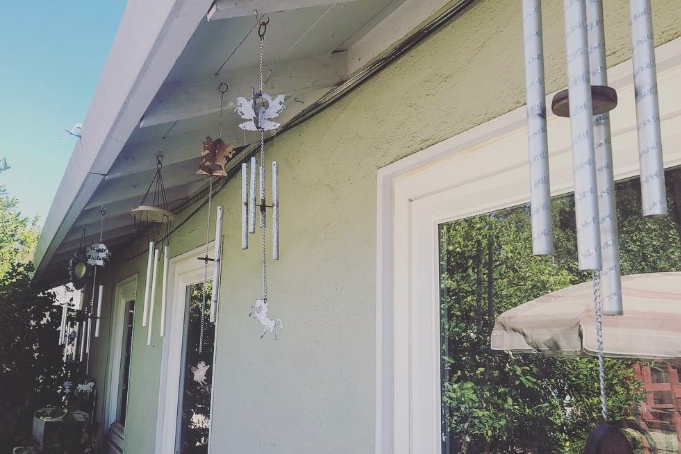
*****The night before she died, I found an essay my grandma wrote for an English class in 1983 when, before life interfered, she attempted to get her Nursing degree. There are those stories. The stories people love. The ones you’ve heard a hundred times. I think, like many of us, I often take those stories for granted. But what a gift the written word is—the ability to have those stories after a person is gone. I hear her voice in every sentence of this essay. And now, like the windchimes, it’s mine to listen to anytime I like. My grandma will be telling me the story of her dog, Pokey, whenever I need to hear it, for the rest of my life. These are her words:
“Pokey”
I loved him so much. For sixteen years, he was part of our lives. We fed him, cleaned him, nursed him, and cursed him. But mostly we loved him, and he loved us.
Jim, that’s my husband, brought this little brown ball of fur home in his coat pocket, at four o’clock, one morning. A peace offering. Of course, Jim denies that was the reason, but how could I be mad at him when presented with this precious little loveable puppy?
Needless to say, our kids were tickled pink when they discovered him in the morning. They were three, four, and five years old at the time, and very into Captain Kangaroo. The Captain used to tell a story on his TV show that our kids dearly loved, “The Pokey Little Puppy.” So it was, our new furry addition became known as Pokey.
That first night he was scared and missed his mother, a beautiful Irish Setter, so he snuggled down under the covers between Jim and me and slept like a baby. Do you know what a mistake it is to take a puppy into your bed when he hasn’t grown into his feet yet? He seemed to double in size every day that first year. Before we knew it, he weighed eighty pounds and took up half the bed. He slept flat on his back, dreamed all night about God knows what, and snored. When we tried to kick him out of bed, his feelings would get hurt. He just couldn’t understand why the other kids could get in bed with Mom and Dad, when they were scared, and he couldn’t. You see, we never bothered to tell him he was a dog.
Pokey loved holidays and special occasions. On Easter, he would hunt baskets and bunny treats in the back yard. Birthday parties always meant lots of kids, fun, cake, and ice cream. Thanksgiving, there was turkey and all the trimmings, not just leftovers, mind you, but his own special plate. Then there was Christmas. Santa always filled Pokey’s stocking that was hung on the mantel with the other kid’s. Christmas morning he would patiently wait, while presents were unwrapped, now and then, sticking his nose in a box to see what someone was particularly excited about. Then the stockings were taken down, emptied on the floor, and inventoried. The year Santa left bicycles for the kids, they ran to get dressed to try out these wondrous machines and there was Pokey, left in total confusion. He started barking and whining. We came into the living room to find Pokey sitting by the fireplace, those big brown eyes saying, “Hey guys, this isn’t the way it’s done.” The kids felt terrible. Jim took the stockings down while the kids petted, soothed, kissed, and apologized. Pokey was thrilled, Santa hadn’t forgotten his Hershey bar.
I’m embarrassed to say, Pokey was a juvenile delinquent. He was arrested, in Berkeley, before he was six months old, for running the streets, a habit we never seemed to break him of. After his brush with the law, we kept him chained in the backyard during the day. He was completely miserable. He wanted so badly to play with the other kids. We moved to Pleasant Hill when he was a year old and he loved the freedom of the huge, fenced backyard. All the kids in the neighborhood would come over and play chase with him. Our problems were over, our baby was happy.
Jim let him outside one morning while he was getting ready for work. Pokey lifted his head and breathed in the crisp, clean air. He stood riveted to the ground for all of a minute, then took off in a dead run, up, up, and away, clearing the six foot fence with a single bound. He also watched Superman on Saturday mornings with the kids. The fences were extended to eight feet, but if there was a female in heat, within ten miles, he was gone. Our little boy had grown up. For the next ten years, this was a constant source of debate. I wanted to have him neutered. My husband argued that we couldn’t take the poor dog’s only pleasure in life away. Being somewhat chauvinistic, by nature, he reasoned if Pokey were a female, we’d have it done, because, “that’s different.”
Jim’s attitude changed when he happened to be home one day and the animal control officer followed Pokey to the house. They never caught him after his first trip to jail. Pokey would spot their truck, run like hell, jump the fence, and pretend he’d been lying in the backyard all day. Jim was working in the front yard when Pokey came running in with the officer hot on his heels. Jim got a ticket, Pokey got a scolding, and I got the dog neutered. The doctor, however, forgot to tell Pokey what the operation was for and the morning after surgery, he proceeded to jump the fence, find a friend, and split his stitches. My husband loved it, typical man, you could see “that’s my boy” written all over his face.
Last year we had Pokey put to sleep. He always hated going to the vet, but he seemed to know this was his last trip. He couldn’t walk anymore, so I carried him in and held him in my arms as the doctor administered his last shot. The house seems larger, our hearts heavier, but the wonderful memories are still there. I loved him so much.
Years ago, a well-meaning but indelibly frank friend of mine offered to give me a ride home from a neighborhood bar. I declined, reminding her that my apartment was merely around the corner of the same block and that it was a beautiful night to walk.
“Are you sure? It’s not a very good neighborhood.”
I felt a fire ignite inside my chest. By the time it reached my lips, I managed to extinguish the flames and replace them with a polite smile. I laughed the laugh we learn to laugh when we are young and a very clever adult insists they’ve stolen our nose long after the jig is up. Looks can be deceiving. A statement is not a fact. And facts are seldom stated. Nevertheless, I stated one to her—a fact I believed to be as plain as the nose lodged in between Aunt Susan’s knuckles.
“It’s a fine neighborhood.”
A simple statement, but a profound truth—one based in experience. Not appearance. As all the truest truths are.
What my friend didn’t know was that at the end of my street there was a mural. A piece of revolving street art, ever changing, with a life and history as intricate as those belonging to every member of the group that would gather before it daily. A human hodgepodge exchanging stories, laughs, and liquor. A scene you might be weary to pass through until you were greeted warmly. But you were always greeted warmly. These corner compatriots: some tenants, some living in tents, and some only pausing on their journey to or from a local business, drawn in by the warm familiarity of the scene, all joined, daily, in fellowship.
My friend didn’t know that the staff of the local restaurants know all the regulars by name and face. And that the bartenders know you by drink. This kind of attention is care that transcends beyond customer service. It is in the service of humanity. An acknowledgement of our shared existence. An effort that whispers gently, I see you and you matter.
My friend didn’t know that there is a woman one building over who punctuates the evenings with the loudest, most exquisite orgasms I have ever heard—a true symphony of ecstasy. I root for her. I once returned home at the precise moment to overhear the following exchange in response to her most enthusiastic moaning:
Neighbor A: “SHUT UP!”
Woman’s Sexual Partner: “You shut up!”
Neighbor A: “F**K YOU.”
Woman’s Sexual Partner: “Actually, I’m f**king her!”
Neighbor B: “Yeah. We ALL know that.”
I applauded the scene as the weight of my day floated away.
On Sunday there’s a lemonade stand. One cup will cost you a dollar and the answer to a curious child’s question. She asks more personal questions than most adults I know. And she is always grateful for your answer.
A few months ago there was a car accident, the unnerving sound of crunching metal mingled with shattering glass and a scream. It took mere seconds for more than twenty concerned strangers to rush out of their homes to see, not if, but how they could be of service.
Most of my neighbors know my cats by name. They have full, albeit one-sided conversations with them concerning such mundane topics as traffic, the weather, and who is a good boy. This an act of great kindness to two formerly abused and abandoned stray cats, as they are still learning and may never fully know how to receive love without fear.
In the Spring, the jasmine flowers that grow untamed on the sides of the buildings and across the fences bloom and sweetest smell wafts down the street, creeping through open windows at the most unexpected and altogether necessary times. It is a scent that heals, soothes, and inspires.
The lights of the observatory on the hill serve as nightly reminder of perspective. A standing testament to our place as a tiny microcosm in the grand scheme of things, they urgently whisper, Look up! Look around! Isn’t it all a wonder?
On summer nights, the air wraps you with it’s warmth. It’s the softest of blankets. And when it’s quiet you can hear the trains pass in the distance, beyond the freeway. If you close your eyes to listen, you could imagine yourself anywhere. This is grown-up magic.
My upstairs neighbor, Cheryl, like me, is a night owl. Our first interaction was a heated argument about mail. Five years later, I hugged her as she cried and relayed the circumstances of the death of her unborn son. I’d watched for months as the promise of new life manifested in the form of fresh Amazon deliveries on her doorstep. As I held her, I wondered what she would do with the crib she had received just that afternoon. A week later, I arrived home after work at nearly 3 AM. Cheryl greeted me at the gate. “Would you like some bacon? I just made it. I’ll bring some down for you.”
Monday and Thursday evenings a farmers’ market is erected outside the metro stop. Amidst the sea of concrete, commuters pause to buy farm fresh tomatoes. Often, these are the tomatoes rejected by the grocery stores because they don’t look perfect. Luckily, people who buy tomatoes outside the metro stop are not interested in perfection.
This is the neighborhood I love. This is my home.
Growing up as the daughter of a working-class, single mother in the suburbs, I witnessed firsthand the powerlessness that comes with being a perpetual renter. So, when investors purchased my apartment complex, I felt a familiar anxiety. Unable to evict due to the restrictions of Los Angeles rent control policies, a sum of money was offered to each tenant as incentive to vacate. We did some math. The investors’ likely return in the first year exceeded this first round of offers by hundreds of thousands of dollars. Further “incentives” manifested in the form of intimidation tactics that lasted for nearly a year.
The first wave of people to go were the newest tenants, untethered to the community, with nothing to lose and plenty of cash to gain. Next were those most fearful of the inevitable scrimmage to follow. Elderly tenants, some who had called this street home for decades, were bullied and threatened. Loss of sleep from constant construction noise, near-daily interruptions in water and gas services, and a slight increase in the value of the offers pushed the next wave of people to leave. More than once I returned home to my apartment filled with a sickening smell. The construction crew had shut off and returned the flow of gas to our stoves and heaters, but failed to reignite our pilot lights, allowing gas to flow freely into our homes. Tenants fearing for the lives of their pets were the next to go.
The vacant units were remodeled to resemble an exhaustingly common modern aesthetic. Carpet was exchanged for cool, gray, faux wood floors. Stainless steel appliances and white cabinetry were installed to justify a rent increase of over a thousand dollars per unit. Meanwhile, the exterior of the building was upgraded with a fresh coat of paint and some drought-resistant landscaping. Up and down the street, this process was repeated until nearly the entire block was remade with surgical precision, a procedural facade lift with a personality reduction.
Through it all, six of over twenty units persisted, some unwilling and others unable to move. Just before the remodeling finished, a final offer was extended. It was a very good offer, one that has caused more than one jaw to drop within my circle of friends. Not enough to ensure I could have stayed local. Not with this rising cost of living. But it was exactly what I had hoped for. Still, I couldn’t bring myself to accept it—a choice that cost me a chunk of change, both monetary and circumstantial. But what would it have cost me to go?
Sitting outside a local cafe one afternoon, I bought a book of self-published poetry from a bearded wanderer. As I thumbed through the pages one phrase stuck:
“It’s not what I leave behind,
but what I can’t leave behind,
that will tell my life story.” (1)
When do we leave that which we love?
And how?
I stayed.
To the dismay of many friends and family.
Against my own logical reasoning.
I stayed.
And honestly—
Sometimes I regret my choice.
Sometimes I’m so grateful for it, I could burst.
Sometimes I look at all the new paint and glass and think it does look nice.
But, is that what makes it good?
Personally, I think not.
I think it’s the lemonade.
And the surprise bacon.
And a million little things that are imperceptible to visitors, even friends.
And especially to real estate developers.
The people I’ve come to know here are not my friends or family. We will never go for a drink or grab a cup of coffee. I probably wouldn’t ask them for a cup of sugar, though I have, in one emergency potato salad situation, borrowed an egg. Still, they are woven into the fabric of my life, inseparable from my understanding of home. Acknowledgment of these peripheral relationships is optional. But doing so makes us better. Happier. (At least me and some studies say so.) It has added value to my life in ways I’m still discovering. What I do know is that life is long. And nothing is permanent. The parts never stop moving.
For those of us left over, we are caught. Between what was and what will be. The street is riddled with vacancies now–entire blocks of storefronts with signs proclaiming their space to be “For Lease.” On the sidewalks below the signs, our neighbors sleep on mounds of cardboard and dirty blankets. This street is their home, too. They’ve been here longer than most. And sometimes I wonder if there will ever come a time when we invest in human life the way we invest in luxury apartments. And sometimes I sit outside cafes, sipping gourmet coffee and reading articles about the growing rate of homelessness in the city, while across the street desperate men and women beg for scraps. We pass the same spots, breathe in the same air, and stand under the same lights. My question shifts:
When did that which they love leave them?
And how?
At the end of my street there was a mural. It marked a gathering place. A co-op of familiar imperfection. A proverbial stoop where diverse individuals found common ground. But they haven’t been around in a long time. Some of the newcomers had a meeting. The wall’s been painted white.
——————————————————————————————————————
(1) an excerpt from Choice of The Heart, R. C. Bates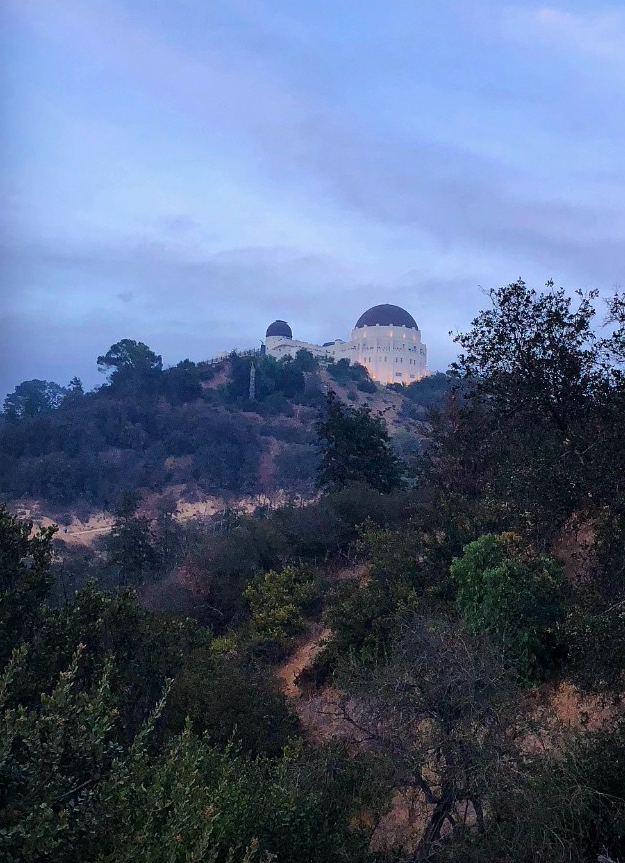 From Below–An Illuminated Griffith Observatory, Los Angeles, CA
I want to ask Him how he’s doing.
I really, really want to.
To make some little conversation out of nothing.
To see if maybe…
To feel a little…
But.
But Experience is in my ear again–
That chatty, old curmudgeon.
Experience says,
“Your question will just be ignored.”
And, Wisdom: Well!
Wisdom is in the corner,
sipping a robust red.
Wisdom chimes in,
“Listen to Experience.
Experience has been where you are.”
So, here I am,
Waiting for Hope.
Hope is stubborn.
Hope wears white after Labor Day.
Hope swears they once saw Burt Reynolds
At an IHOP.
Hope defies Experience.
Hope challenges Wisdom.
Hope says,
“Maybe this time will be different.”
Sure, Hope is mostly wrong.
But Hope is undeterred.
Hope believes in possibilities.
Hope isn’t always the friend you need.
Still,
It’s nice to catch up sometimes.
Meanwhile…
That bastard, Irony, is on the train,
And that fucker’s ready with the jokes.
And this is how a poem changes tone
When we learn
that his new girlfriend,
Is named
‘Hope.’
 The Hurt and The Happy